Description
Agibot G2 Robot: Complete Guide to the Industrial-Grade Interactive Humanoid
Introduction / Overview
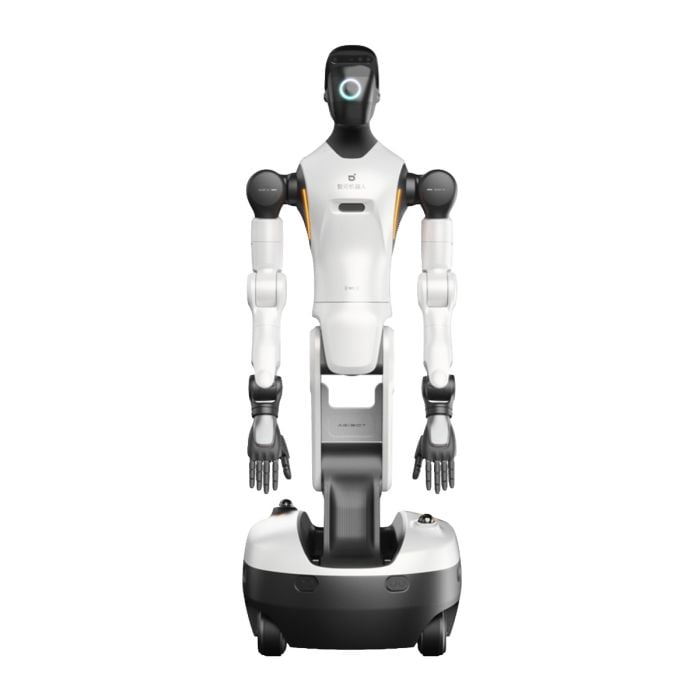
The Agibot G2 is a next-generation industrial-grade interactive embodied humanoid robot developed by AgiBot Innovation (Shanghai) Technology Co., Ltd. Officially launched on October 16, 2025, the G2 is a wheeled humanoid designed for high-precision manipulation, continuous 24/7 operation, and safe human-robot collaboration in real-world industrial environments. It represents a significant upgrade over AgiBot’s earlier embodied-operation platform first introduced in November 2023.
Unlike traditional industrial robots that perform fixed, one-way operations, the Agibot G2 humanoid robot is built around what AgiBot describes as a “interaction + AI” philosophy. It combines force-controlled dual arms, omnidirectional mobility, multimodal voice interaction, and onboard artificial intelligence to handle complex, long-sequence tasks across manufacturing, logistics, and guided-tour scenarios. The platform is positioned as a scalable, general-purpose embodied intelligence solution intended for immediate large-scale commercial deployment.
This comprehensive guide covers the design, technical specifications, applications, advantages, comparisons, and availability of the Agibot G2, along with a detailed FAQ optimized to answer the most common questions about this industrial humanoid robot.
Design and Features
Physical Build and Structure
The Agibot G2 is a wheeled humanoid robot standing approximately 1,795 mm (about 1.8 meters) at full extension and adjustable down to around 1,225 mm. It measures roughly 760 mm in length and 640 mm in width, with a total weight of about 185 kg including batteries. The robot is constructed using automotive-grade components engineered for durability in continuous industrial operation.
A defining feature of the G2 is its 3-degree-of-freedom (DoF) waist, which accurately simulates human-like movements such as bending, twisting, and side-swaying. Combined with a lower-body design that allows squatting, the robot can reach working heights between roughly 1.3 and 1.8 meters without requiring a fixed base—an important capability for tasks at varying workstation heights.
Force-Controlled Dual Arms
The manipulator system is among the G2’s most notable design elements. Each arm offers 7 degrees of freedom and uses a “cross-shaped wrist” force-controlled design with high-precision torque sensors across the entire arm. This enables the robot to detect external forces in real time and respond smoothly via impedance control. The absolute force-control accuracy is finer than 0.5 Newtons, and each arm supports a rated payload of approximately 5 kg.
This level of sensitivity allows the Agibot G2 to perform delicate, contact-rich tasks such as component insertion, alignment, and fastening. In live demonstrations, AgiBot showed the arm responding gently when pushed against a raw egg without breaking it—a vivid illustration of its compliant force control.
Mobility and Endurance
The G2 uses a four-wheel steerable chassis that delivers omnidirectional mobility, including lateral “crab walking” and zero-radius rotation, with a top speed around 1.5 m/s. For endurance, it relies on dual hot-swappable batteries and an autonomous charging function, supporting genuine 24/7 continuous operation aligned with factory production rhythms. Maximum operating time is reported at roughly 240 minutes per battery cycle.
Interactive and Expressive Capabilities
Beyond manipulation, the G2 emphasizes human-robot interaction (HRI). It supports multi-user conversation, eye-gaze tracking, and expressive facial animations, along with human-like body language. These features make it suitable for guided tours, reception, and exhibit-style demonstrations where communication matters as much as task execution.
Technology and Specifications
Onboard AI and Compute
The Agibot G2 is powered by AgiBot’s in-house foundational large model GO-1 (Genie Operator-1) and its world model GE-1. GO-1 employs a “3-layer brain” architecture: a Vision-Language Model (VLM) for perception, a Latent Planner for planning, and an Action Expert for execution. This Vision-Language-Latent-Action (VLLA) approach enables the robot to understand a single high-level command and complete an entire multi-step task. The GE-1 world model adds predictive capability, allowing the robot to “rehearse” actions in a simulated visual environment before executing extended, intricate operations.
On the hardware side, the G2 integrates the NVIDIA Jetson Thor T5000, delivering up to 2,070 TFLOPS (FP4) of onboard computing power, supplemented by AgiBot’s Rhino R1 providing additional base compute. This allows large AI models such as VLAs and LLMs to run directly on the device, processing multiple sensor streams locally with latency under 10 milliseconds.
Sensor Suite and Perception
The robot’s perception system provides 360-degree spatial awareness through a hardened sensor array that includes LiDAR units, a stereo camera, multiple fisheye cameras, and an RGB-D camera, plus a microphone array and speaker for voice interaction. This sensor fusion enables full-scene omnidirectional obstacle avoidance, autonomous indoor navigation, and hazard prediction for safe operation around people.
Key Specifications at a Glance
Specification Detail
Type Wheeled humanoid robot
Total degrees of freedom 26 DoF
Arms 2 × 7-DoF force-controlled
Arm payload ~5 kg per arm
Force-control accuracy < 0.5 N
Height (standing) ~1,795 mm
Weight ~185 kg (with batteries)
Mobility 4 steerable wheels, omnidirectional, ~1.5 m/s
Onboard compute NVIDIA Jetson Thor T5000 (up to 2,070 TFLOPS FP4) + Rhino R1
AI models GO-1 foundation model, GE-1 world model
Ingress protection IP42 (chassis); IP50 (arms)
Battery Dual hot-swappable, ~240 min max operating time
Connectivity Wi-Fi, 4G/5G, Bluetooth 5.2, NFC
Operating temperature Tested -15°C to 50°C
Reliability Engineering
The Agibot G2 emphasizes industrial-grade quality, having passed more than 130 component tests and extreme trials including temperature extremes from -15°C to 50°C, electrostatic protection, and emergency braking. The chassis carries an IP42 rating for dust and water resistance, while the arms are rated IP50 to protect internal actuators.
Applications and Use Cases
The Agibot G2 is designed as a general-purpose platform adaptable to a wide range of industrial and commercial scenarios:
Manufacturing and assembly. The G2 collaborates with human operators on tasks such as automotive seatbelt lock cylinder assembly, material handling, machine tending, and quality inspection. In one demonstration, its force-controlled arms learned a delicate RAM-insertion task within about an hour. In April 2026, G2 robots were deployed on a live tablet production line at Longcheer Technology, working at Multimedia Integrated Testing stations—reportedly achieving throughput up to 310 units per hour, cycle times around 19–20 seconds, and a success rate exceeding 99.9%, with line integration completed within 36 hours.
Logistics and warehousing. Equipped with AgiBot's high-degree-of-freedom OmniHand dexterous gripper, the G2 can grasp parcels of varying sizes, shapes, and materials for parcel feeding, loading, and sorting. Its strong mobility lets it adapt to over 95% of factory floor conditions.
Guided tours and reception. Using a customized knowledge base, human-like body language, and 360-degree perception, the G2 can serve as a museum guide, receptionist, or interactive exhibit at trade shows and visitor centers.
Security, inspection, education, and research. AgiBot offers SDK interfaces for industry-specific customization and is expanding the platform into security patrols, facility inspection, and as a base for AI research and embodiment-model development.
Advantages and Benefits
The Agibot G2 offers several distinct benefits for businesses considering embodied automation:
Sub-millimeter precision with compliant contact, enabling delicate assembly tasks that would otherwise require custom fixtures or tooling.
Rapid deployment, with a dedicated toolchain that lets non-specialist users set up the robot, sometimes within a single day, and one-click deployment from simulation to physical hardware.
24/7 continuous operation via dual hot-swappable batteries and autonomous charging, matching the cadence of round-the-clock production lines.
Adaptability to high-mix manufacturing, where the robot can be "taught" new procedures quickly when SKUs or fixtures change—addressing a common bottleneck in flexible production.
Safe human-robot collaboration, supported by force control and human-aware navigation, allowing the robot to share space with human operators.
On-device AI, which reduces latency, improves generalization, and shortens development timelines.
Comparisons
The Agibot G2 sits within a competitive and fast-evolving humanoid robotics landscape that includes platforms such as Tesla's Optimus, Figure's Figure 03, Unitree's humanoids, and others. A key differentiator of the G2 is its wheeled rather than bipedal locomotion, which trades the ability to climb stairs for greater stability, simpler control, and lower cost—advantages well-suited to flat factory and warehouse floors.
Compared with traditional fixed industrial robotic arms, the G2's mobility, dual-arm dexterity, and interactive intelligence allow it to handle a broader variety of tasks without dedicated tooling. Within AgiBot's own lineup, the G2 is the industrial-grade interactive model, complementing the company's other products such as the G1, X2, and A2. Prospective buyers should evaluate the G2 against alternatives based on task type, floor environment, payload needs, and total cost of ownership.
Pricing and Availability
The Agibot G2 was officially launched in October 2025 and made its first public offline debut at IROS 2025 in November 2025. As of mid-2026, it is in active commercial deployment, beginning with automotive parts manufacturing and consumer electronics precision manufacturing.
AgiBot has not published a single fixed public list price for the G2, and pricing for industrial humanoid robots typically depends on configuration, accessories (such as the OmniHand professional gripper), software customization, and order volume. Commercial viability has been signaled by a framework order for nearly 1,000 G2 units associated with manufacturing partner Longcheer. Organizations interested in procurement, pricing, or pilot deployments are advised to contact AgiBot or an authorized distributor directly for a tailored quote.
FAQ
What is the Agibot G2?
The Agibot G2 is an industrial-grade interactive humanoid robot from AgiBot (Shanghai), launched in October 2025. It is a wheeled humanoid with 26 total degrees of freedom, dual 7-DoF force-controlled arms, omnidirectional mobility, and onboard AI, designed for precision manipulation, human-robot interaction, and continuous operation in factories, warehouses, and public venues.
How does the Agibot G2 work?
The Agibot G2 combines a hardened sensor suite (LiDAR, stereo, fisheye, and RGB-D cameras) with onboard NVIDIA Jetson Thor compute and AgiBot's GO-1 foundation model and GE-1 world model. The GO-1 model uses a three-layer "brain"—perception, planning, and execution—to translate a single command into a complete multi-step task, while force-controlled arms execute precise, contact-aware movements.
Why is the Agibot G2 important?
The Agibot G2 is significant because it moves embodied AI from controlled demonstrations to real, large-scale industrial use—operating on live production lines alongside human workers. Its combination of dexterity, mobility, interaction, and rapid deployment makes it a benchmark for general-purpose industrial humanoids and a sign of how embodied intelligence is entering mainstream manufacturing.
What are the benefits of the Agibot G2?
Key benefits include sub-millimeter assembly precision, safe human-robot collaboration through force control, 24/7 operation via hot-swappable batteries, rapid setup without specialized skills, adaptability to high-mix production, and powerful on-device AI that lowers latency and shortens development time.
What can the Agibot G2 be used for?
The Agibot G2 is used for manufacturing assembly, quality inspection, machine tending, logistics sorting and material handling, guided tours and reception, security patrols, facility inspection, and AI research. It has been deployed in automotive parts manufacturing and consumer electronics production lines.
Is the Agibot G2 a bipedal or wheeled robot?
The Agibot G2 is a wheeled humanoid. It uses a four-wheel steerable chassis offering omnidirectional movement, including lateral crab-walking and zero-radius rotation, which provides stability and efficiency on flat industrial floors.
How much does the Agibot G2 cost?
The AgiBot G2 is US$138,000.00 and is available for sale now.
Summary
The Agibot G2 stands as one of the most capable industrial-grade interactive humanoid robots available today. By uniting force-controlled dual arms, omnidirectional wheeled mobility, a comprehensive 360-degree sensor suite, and powerful onboard AI driven by the GO-1 and GE-1 models, it bridges the gap between laboratory demonstrations and real-world factory deployment. Its proven performance on live production lines, rapid deployment toolchain, and 24/7 operational endurance make it a compelling solution for manufacturing, logistics, and service applications. As embodied intelligence continues to mature, the Agibot G2 represents a clear and authoritative example of how general-purpose humanoid robots are reshaping the future of industrial automation.
Reviews
There are no reviews yet.